
Custom Staircase Full Process Quality Inspection Standard Manual
Applicable Standards: GB 50368-2005 Residential Building Code, GB 50205-2020 Code for Acceptance of Construction Quality of Steel Structures, GB 50206-2012 Code for Acceptance of Construction Quality of Timber Structures
Inspection Sequence: Document Verification → Overall Structure → Dimensional Accuracy → Safety Protection → Surface Finish → Hardware Accessories → Functional Testing → Final Acceptance
01
Pre-Inspection Preparation (10 minutes)
1.1 Essential Inspection Tools
Purpose: Ensure accurate and reliable measurement data
5m Steel Tape Measure (Accuracy ±1mm)
2m Straight Edge + Feeler Gauge (Accuracy 0.5mm)
Laser Level (Cross-line/16-line recommended)
Vernier Caliper (Accuracy 0.02mm)
50kg Force Gauge
High-intensity Flashlight
Try Square
Marker Pen + Sticky Notes
110mm Diameter Test Gauge (for railing gap inspection)
1.2 Document Verification
Purpose: Confirm product consistency with contract specifications
Verify material, specifications, color, and quantity as stated in the contract
Check main material test reports (steel plate thickness, wood grade, glass 3C certification)
Inspect hardware brand, model, and warranty certificates
Confirm installation drawings match actual site conditions
Check construction unit qualifications and installer certifications
02
On-site Core Inspection Process (Approx. 60-90 minutes)
2.1 Overall Dimensions and Verticality Inspection
Purpose: Ensure staircase fits building space without tilt or deformation
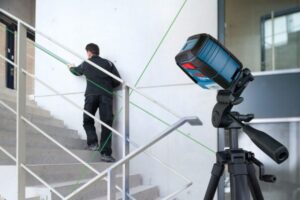
Figure 1: Using laser level to measure staircase verticality
Project vertical reference line with laser level, overall verticality tolerance ≤3mm/2m
Measure total height, length, and width of staircase, deviation from drawings ≤±10mm
Check gaps between staircase and walls/floor, uniformity ≤2mm, caulking full without bubbles
Measure landing levelness with level, tolerance ≤2mm/2m
Verify headroom clearance ≥2200mm (to prevent head injuries)
2.2 Tread Dimensional Accuracy Inspection (Most Problem-prone Area)
Purpose: All treads must have consistent dimensions to prevent tripping hazards
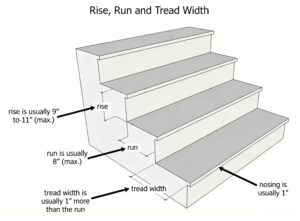
Figure 2: Standard stair rise, run, and tread width measurements
Inspection Item | Measurement Method | Acceptance Standard |
Tread Height | Measure left, middle, and right points of each step | Single step deviation ≤±3mm, adjacent step height difference ≤3mm |
Tread Width | Measure front, middle, and rear points of each step | Single step deviation ≤±5mm, adjacent step width difference ≤5mm |
Tread Depth | Measure distance from front edge to back edge of tread | Residential ≥220mm, Public buildings ≥260mm |
Riser Verticality | Measure with try square | Deviation ≤2mm |
Important Note: The topmost tread must be flush with the floor slab, height difference ≤5mm; all steps must be measured individually, no sampling allowed.
2.3 Structural Stability Inspection (Safety Core)
Purpose: Prevent staircase collapse or excessive shaking
2.3.1 Main Beam/Stringer Inspection
Check main beam material thickness: Steel staircase main beam ≥6mm, wood staircase main beam cross-section ≥120×80mm
Inspect main beam connections to walls/floor: Must use chemical anchors, not just expansion bolts
Main beam spacing ≤400mm, at least one support stringer under each tread
Check for main beam deformation, bending, or weld cracks
2.3.2 Connection Inspection
All welds: Full penetration, no cold welds, no slag inclusions, proper rust prevention
Bolt connections: Must use stainless steel bolts, 2-3 threads exposed after tightening
Joints: Gap ≤1mm, no looseness or displacement
Inspect all concealed connections, remove decorative covers if necessary
2.3.3 Shake and Load Test
Shake handrail firmly horizontally, deflection ≤5mm
Press handrail firmly vertically, deflection ≤2mm
Stamp firmly on center of tread with one foot, no obvious vibration or noise
Multiple people walk up and down simultaneously (total weight approx. 300kg), observe overall structure for deformation
Optional: Place 150kg weight on center of tread, leave for 24 hours, check for permanent deformation
2.4 Safety Protection System Inspection (Top Priority)
Purpose: All designs must comply with child safety standards
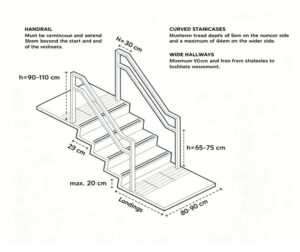
Figure 3: Standard staircase safety dimensions
Inspection Item | Acceptance Standard | Non-compliance Consequence |
Railing Gap | ≤110mm (110mm test gauge cannot pass through) | Child’s head can pass through leading to fall |
Handrail Height | Residential ≥900mm, Over 1050mm for high-rise buildings | Risk of falling over |
Handrail Diameter | 30-50mm (comfortable grip) | Too thin: slippery; Too thick: hard to hold |
Anti-slip Treatment | Tread front edge must have anti-slip strip, protruding 2-3mm | Slipping hazard in wet conditions |
Sharp Edge Treatment | All corners must be chamfered R≥2mm | Serious injury from bumps |
Glass Railing | Must use 6+6 laminated tempered glass with 3C mark | Ordinary glass breaks easily causing injury |
Important Note: Railings must not have horizontal designs (to prevent children from climbing); bottom must have 100mm high kick plate; glass must be fixed on all four sides, not just top and bottom.

2.5 Surface Finish and Appearance Inspection
Purpose: Ensure aesthetics and durability
Inspection Environment: Natural light, viewed from 1 meter distance
Paint Finish Inspection
No runs, bubbles, pinholes, or orange peel effect
Color difference ΔE≤2 (barely distinguishable to naked eye)
Smooth to touch, no graininess
Wood staircase paint must cover all surfaces including back and bottom
Lightly scratch with coin, no obvious marks (hardness ≥2H)
Material Appearance
Wood: No cracks, insect holes, dead knots, natural grain
Steel: No scratches, rust spots, uniform coating
Glass: No scratches, bubbles, impurities, smooth edges
Aluminum: No oxidation, color difference, uniform surface treatment
Joint Craftsmanship
Wood joints: Gap ≤0.5mm, aligned grain
Metal joints: Gap ≤0.3mm, no burrs
Glass joints: Uniform gap, full and transparent caulking
2.6 Hardware Accessories and Functional Inspection
Purpose: Hardware determines staircase service life
General Requirements
All hardware must be 304 stainless steel or galvanized material
Smooth surface, no burrs or rust spots
Screws fully tightened with no exposure, caps complete
Special Inspections
Hinges: Open and close 10+ times, smooth without jamming or noise
Anchor bolts: Must be fixed to concrete base, not wooden floor
Handrail connectors: No gaps or looseness, smooth feel
Step lights: Power on test, uniform brightness, no flickering
Door locks (if any): Flexible operation, smooth latch extension
03
Defect Recording and Acceptance Conclusion
3.1 Defect Classification Standards
Critical Defects: Structural looseness, railing gap exceeding standard, glass without 3C certification, tread height difference >10mm (Must be rectified immediately, use prohibited otherwise)
General Defects: Paint scratches, slightly loose hardware, uneven gaps (Rectify within 7 days)
Minor Defects: Local color difference, small area bubbles (Negotiable treatment)
3.2 Acceptance Conclusion
Passed: No critical defects, ≤2 general defects, ≤5 minor defects
Acceptance After Rectification: Critical defects present or >3 general defects, re-inspect after rectification
Failed: Multiple critical defects, cannot be rectified or still non-compliant after rectification
04
Post-Inspection Notes
All defects must be recorded in writing and signed by both parties
Keep inspection report and acceptance form as warranty basis
Avoid heavy impact and large number of people stepping on within 7 days after installation
Inspect connection tightness and paint condition annually
Maintain indoor humidity at 40%-60% for wood staircases to prevent cracking and deformation